How to automate high-volume hiring: where the time goes, which steps to automate, and how to keep people accountable for every hiring decision.
Automating high-volume hiring means using software to handle the repetitive work of a large applicant pool, so recruiters spend their time on people rather than paperwork. It matters most to operations teams that hire often or in bulk, where one opening can attract far more resumes than anyone can read carefully. Done well, automation shortens the routine steps and keeps the process consistent. Done carelessly, it can hide poor decisions behind a score.
Key takeaways
- Most recruiter time in volume hiring goes on reading, comparing, scheduling and chasing, which are the steps worth automating.
- Use automation to organise and support decisions. Keep a named person accountable for every shortlist and offer.
- Define job-related criteria first; software cannot fix vague requirements.
- Tell candidates how their information is used and keep their status visible.
- Test any AI scoring for fairness and accuracy before you rely on it, and keep reviewing it.
Where does the time go in high-volume hiring?
The time goes on repetitive coordination rather than on judgement. For an operations team filling many similar roles, the same tasks repeat with every opening:
- Reading and comparing a large number of resumes, one at a time.
- Applying screening criteria that differ slightly between reviewers.
- Writing or finding assessment questions for each role.
- Arranging interview slots through long email exchanges.
- Answering candidates who ask where their application stands.
- Keeping stages, targets and communication consistent across many openings.
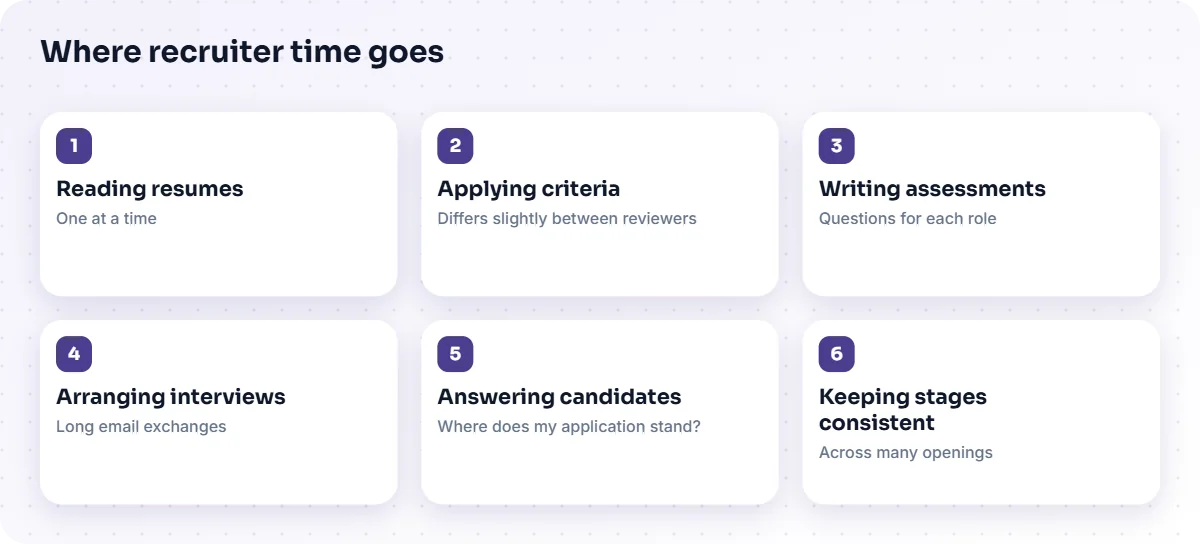
Each task is small. Multiplied across a large pool, together they decide how fast a team can hire.
Which steps are worth automating?
Automate the steps that are mechanical or repeated, and keep the evaluative steps with people. The table shows a sensible division.
| Step | What automation can do | What people keep |
|---|---|---|
| Resume intake | Convert PDF and DOCX resumes to structured data | Checking unusual or incomplete profiles |
| Screening | Score against the job description and show reasons; rank in bulk | Deciding who is shortlisted |
| Assessment | Generate role-related quizzes; gate the next stage by configured rules | Judging results alongside other evidence |
| Scheduling | Let candidates pick from available slots | Choosing interview panels |
| Communication | Send templated status updates at each stage | Personal messages, offers and difficult news |
| Oversight | Track stage progress and service-level targets | Acting on delays |
The AI Recruitment & Talent Screening Platform from TecBytz is designed around this division. It parses resumes, scores candidates from 0 to 100 with explanations, supports bulk analysis, generates job-specific quizzes, provides a candidate portal and interview self-scheduling, and offers configurable stages. Details are on the AI Recruitment & Talent Screening Platform page.
How do you define criteria before you automate?
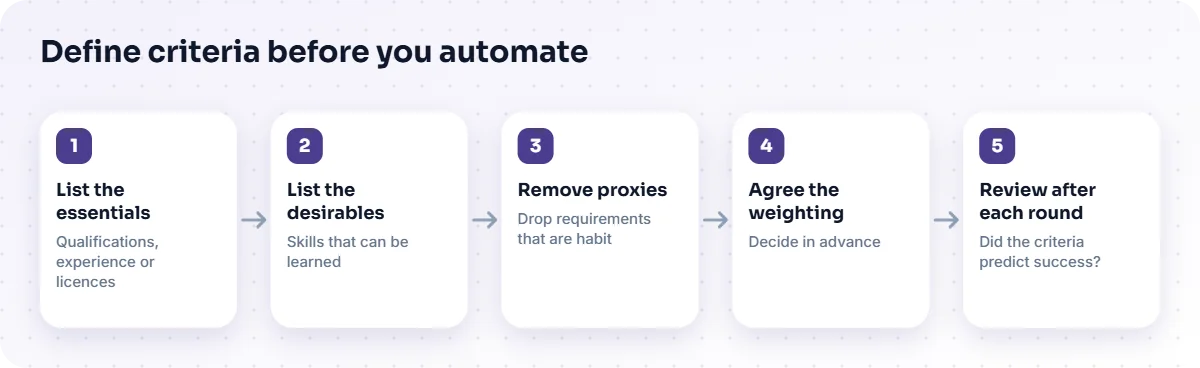
Write the criteria in plain, job-related terms before any tool scores anyone. Vague requirements produce arbitrary rankings. For each role, separate what is essential from what is desirable, and state each in terms that can be checked against a resume or an assessment.
- List the essentials. Qualifications, experience or licences without which the person cannot do the job.
- List the desirables. Skills that help but can be learned.
- Remove proxies. Drop requirements that are habit rather than need, since they can exclude capable people.
- Agree the weighting. Decide in advance how much each criterion counts.
- Review after each round. Check whether the criteria predicted who succeeded.
How should a score be used?
A score is an aid to review, not a measure of a person's overall ability. Read the explanation, look at the candidate's evidence and treat the ranking as a way to decide where to look first. Never reject a candidate on a number alone. A recruiter should be able to say why a person was or was not shortlisted in their own words.
No scoring system is always accurate. Its performance has to be measured against a defined method and the relevant applicant population, and it should be rechecked as roles and pools change.
How do you keep volume hiring fair?
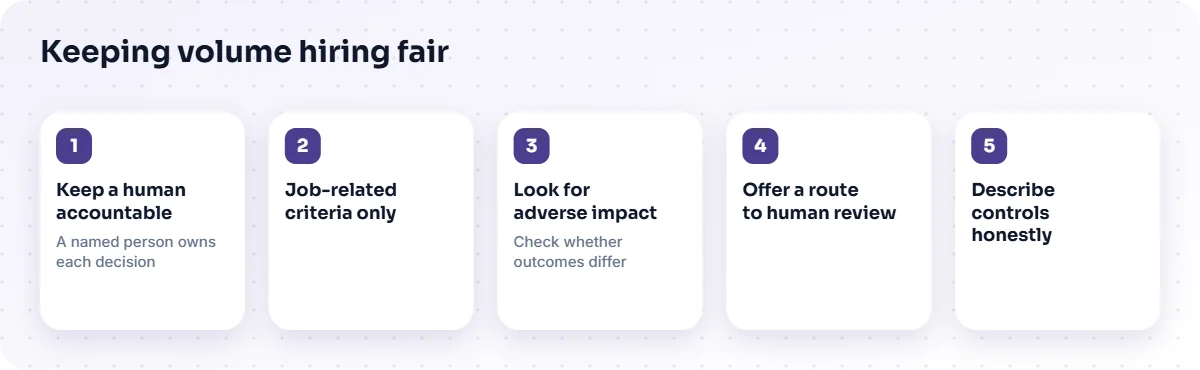
Fairness comes from the process around the tool as much as the tool itself. Practical steps:
- Keep a human accountable. A named person owns each screening, shortlisting and hiring decision.
- Use job-related criteria only. Avoid inferring personality, health or protected characteristics.
- Look for adverse impact. Check whether outcomes differ for particular groups, record what you find and act on it.
- Offer a route to human review. Candidates should be able to ask for clarification or a person to look again, as the law and your policy require.
- Describe controls honestly. Anti-cheat controls on assessments reduce cheating; they do not make it impossible.
Data handling needs the same care: decide what is kept, for how long and who can see it, and tell candidates.
What does the candidate experience look like?
Candidates want to know where they stand and what happens next. A portal with live status, clear stages and self-service scheduling removes most of the "any update?" messages, and templated emails keep everyone informed at key events. Good communication also protects your employer brand, which matters when you hire in bulk.
How do you roll it out?
Start with one role family that you hire for repeatedly, and measure before and after. Run the new workflow beside the old for a short time, compare shortlists, and let recruiters challenge the scores. Expand once the team trusts the process. Our business process automation team helps design the stages, our AI solutions team covers the AI components, and our enterprise application integration team connects the platform to the systems around it. For the next question buyers ask, see choosing a recruitment management system that integrates with HR and payroll.
How do you measure whether automation is working?
Measure the outcomes you care about before and after, using the same definitions. Useful measures include the time from application to first response, the time from application to offer, the share of candidates who complete each stage, recruiter hours spent on scheduling and the number of candidate queries about status. Also track quality: how many shortlisted candidates progress, and how new hires perform after a few months.
Compare like with like. A change in the mix of roles or in the applicant pool can look like an improvement or a decline, so note what else changed. Review the results with recruiters and hiring managers, who will often spot problems that the numbers do not show.
What about accessibility for candidates?
Every stage should work for candidates who use assistive technology, have limited connectivity or need adjustments. Test the portal, the forms and the assessments with keyboard-only navigation and a screen reader, offer an alternative route for people who cannot complete an online step, and say clearly how to ask for an adjustment. A process that excludes capable people by design undermines the purpose of hiring well.
Frequently asked questions
Can AI choose who to hire?
It should not. It can organise, score and rank to support review. People remain accountable for hiring decisions.
What is bulk resume analysis?
Processing and scoring a large group of resumes together, so recruiters can review a ranked list instead of opening each one first.
Does automation reduce bias?
Not automatically. It can make criteria more consistent, but it can also repeat bias in the criteria or data. Test for adverse impact and keep reviewing.
What should we automate first?
Scheduling and candidate communication are usually the lowest-risk, highest-relief steps. Add screening support once your criteria are clear.
Next step
Pick your busiest role family and write down the essential criteria in plain words. If it takes an argument, that is worth resolving before any software. When you are ready to see how a workflow could look, review the AI Recruitment & Talent Screening Platform or book a discovery call.
Last updated: