

How machine learning moves telecom network operations from reactive firefighting to predictive maintenance, smarter ticketing and better site power management.
Key takeaway: AI helps telecom operators move network operations from reactive firefighting to prediction: correlating alarms to a root cause, predicting equipment and power failures, and dispatching field teams more intelligently. It works best as a layer on top of existing OSS/BSS and NOC systems, starting with one high-friction process.
From reactive to predictive operations
Traditional telecom network management is reactive: an incident occurs, an alarm fires in the network operations center (NOC), and engineers are dispatched to diagnose and fix the fault. As networks grow and data traffic rises, this model struggles to keep up.
Machine learning models trained on continuous telemetry, such as RAN performance metrics, power stability and traffic patterns, can flag equipment degradation before it becomes an outage, so teams act earlier.
Where does AI help most in telecom operations?
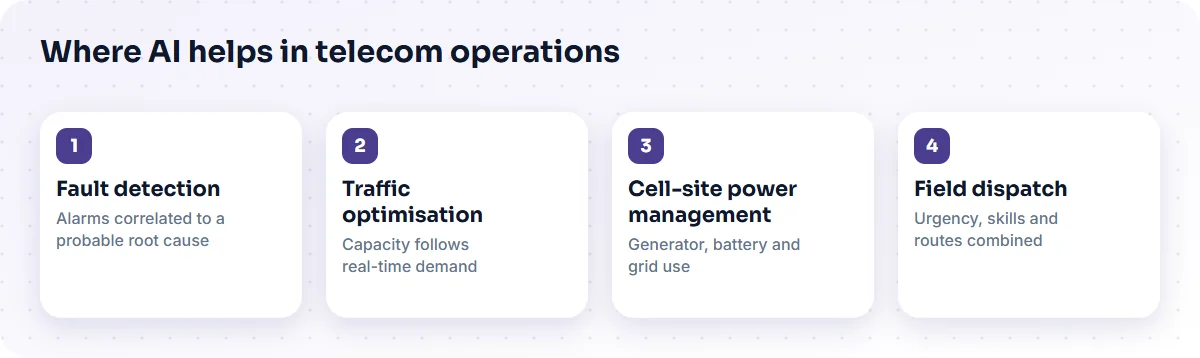
- Fault detection: pattern recognition correlates large numbers of simultaneous alarms down to a probable root cause.
- Traffic optimisation: models help allocate capacity based on real-time demand patterns.
- Cell-site power management: generator runtime, battery switching and grid power use can be monitored and optimised across remote sites.
- Field dispatch: ticket urgency, technician skills and routes are combined to plan maintenance visits.
What does this look like in practice in the Gulf?
Automation is the foundation AI builds on. In our work with Huawei and Ooredoo Oman, TecBytz delivered the Passthrough DG module, which collects tower power and generator data in real time and automates partner payment calculations, and digitized NOC workflows with automated ticketing and compliance checks. Clean, real-time operational data like this is exactly what predictive models need.
Key takeaways for telecom CIOs and CTOs
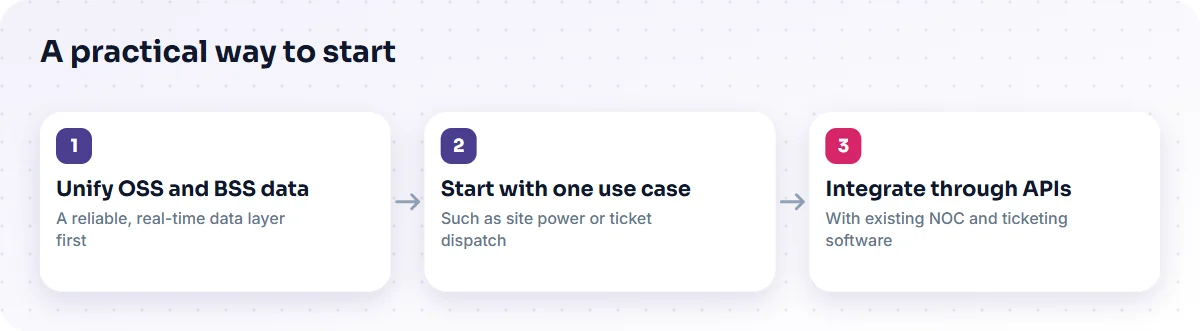
- Unify OSS and BSS data into a reliable, real-time operational data layer first.
- Start with a targeted, high-friction use case such as site power management or ticket dispatch.
- Integrate AI with existing NOC and ticketing software through APIs rather than replacing it.
Frequently asked questions
How long does it take to implement AI in telecom operations?
It depends on data readiness and scope. A focused use case built on existing, reliable data can be delivered much faster than a network-wide programme; we agree a timeline after discovery.
Does AI replace legacy OSS/BSS software?
No. AI works as an intelligent layer that connects to legacy OSS/BSS systems through enterprise APIs, without requiring full system replacement.
Last updated: